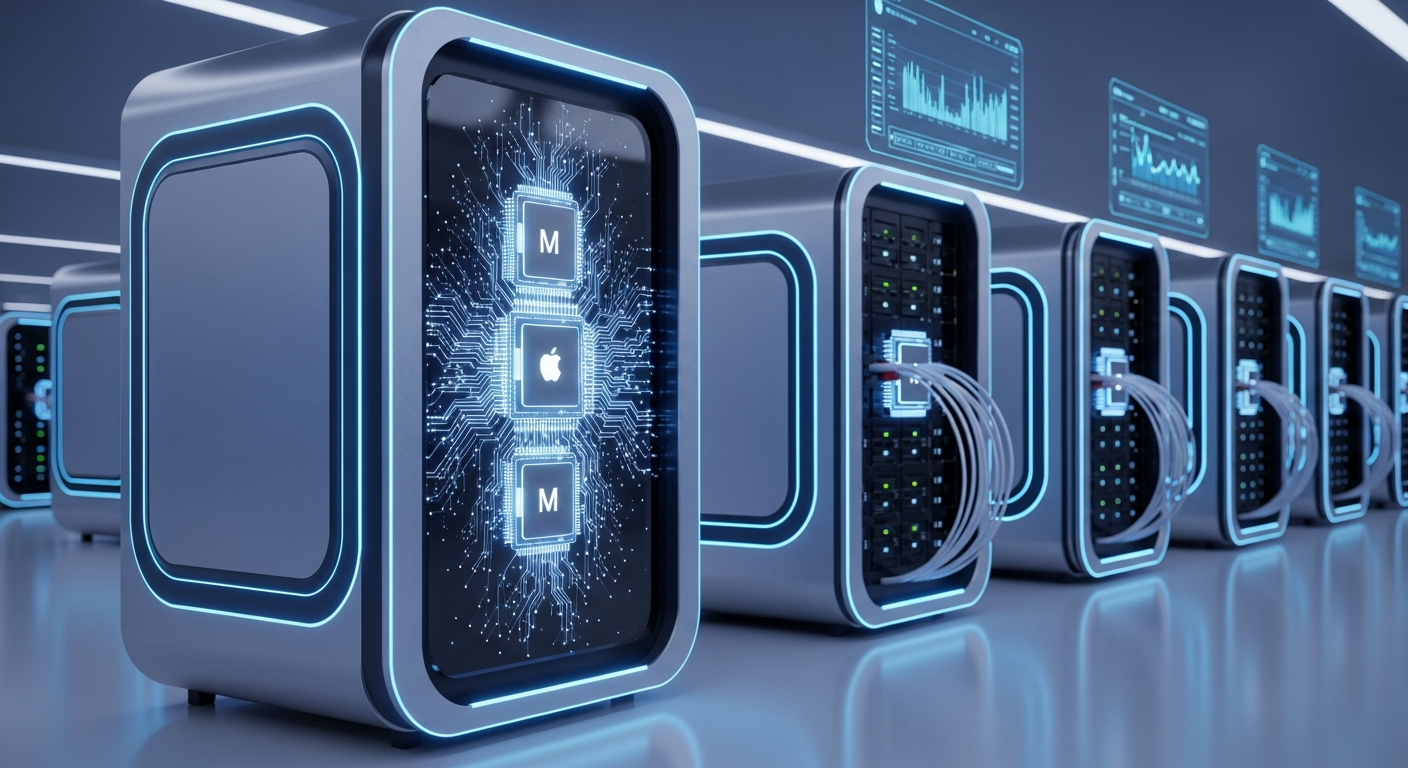
Could Apple Silicon Replace x86 in the Server Room?
Apple Silicon changed the laptop game. Here is why it probably will not replace x86 in datacenters any time soon, and what would need to change.
The Performance Argument
Apple Silicon delivers incredible performance per watt. The M-series chips consistently outperform Intel and AMD in single-threaded workloads while sipping power. If you have used an M-series Mac, you know the difference is real. Fans rarely spin up, battery life is outstanding, and sustained performance is genuinely impressive.
So why not put that efficiency into a server?
What Servers Actually Need
Server workloads are different from desktop workloads. Servers need massive memory capacity, ECC support at scale, high-bandwidth I/O, and standardized management interfaces. The current Apple Silicon lineup maxes out at 192 GB of unified memory on the M2 Ultra, which sounds like a lot until you realize that a single PowerEdge R740 can hold 3 TB.
Servers also need PCIe lanes for network cards, storage controllers, and accelerators. Apple's approach of integrating everything into the SoC is brilliant for laptops but limiting for servers that need to be configured for specific workloads.
The Software Problem
Even if Apple built the perfect server chip, the software ecosystem is not ready. The vast majority of server software is built and tested for x86 Linux. Yes, ARM servers exist (AWS Graviton is a great example), but Apple's ARM implementation runs macOS, not Linux. Running Linux on Apple Silicon is possible through projects like Asahi Linux, but it is not production-ready for server workloads.
What I Think Will Happen
Apple will probably never make a traditional rack-mount server again. But Apple Silicon will continue to find its way into edge computing, media processing pipelines, and development infrastructure. The Mac Pro with Apple Silicon (if and when it arrives) will likely be positioned as a workstation, not a server.
For general-purpose server workloads, x86 (and increasingly ARM via Graviton and Ampere) will remain dominant. The economics and ecosystem are just too established for Apple to disrupt without a fundamentally different approach.
The Takeaway
Apple Silicon is incredible technology. It just solves a different problem than what most servers need. Understanding that distinction is important for anyone evaluating infrastructure decisions.