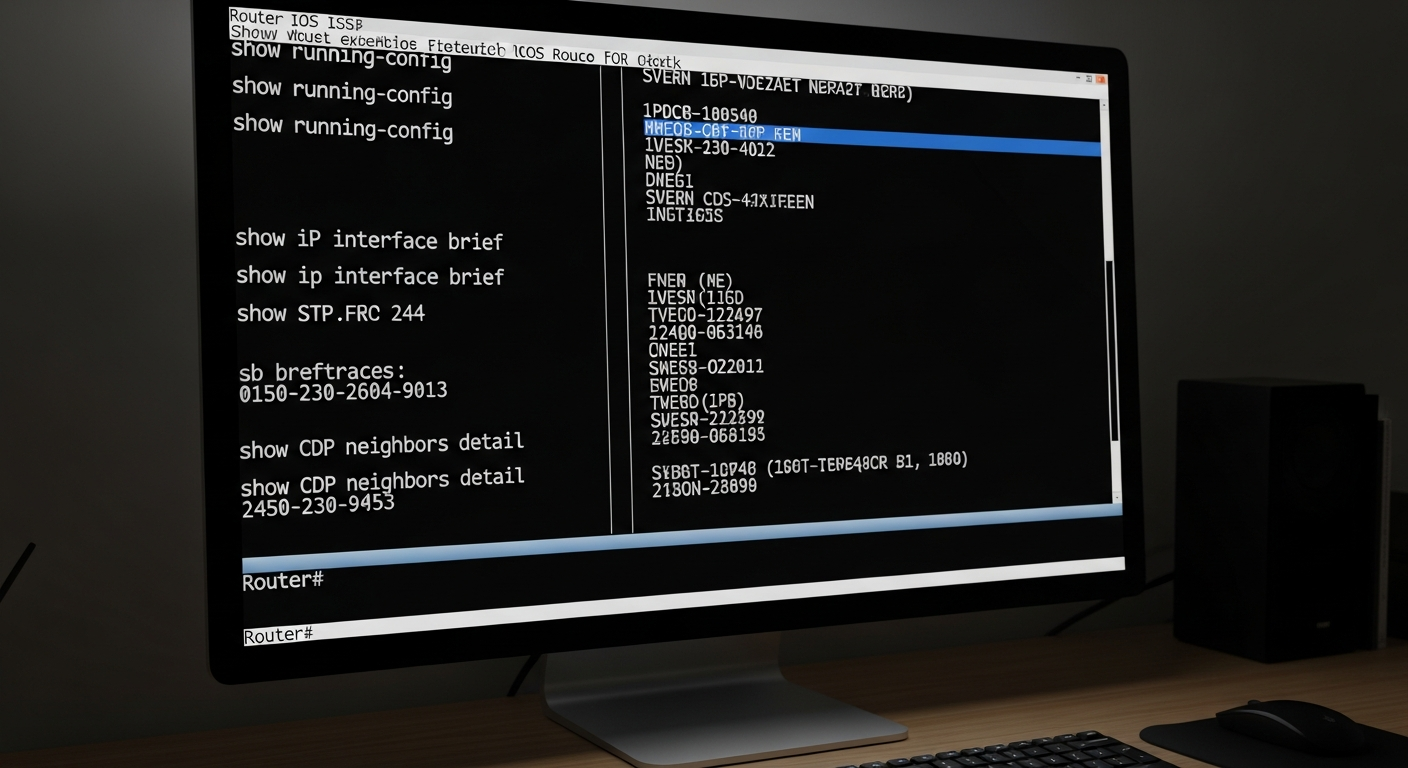
Cisco IOS Fundamentals Every Network Engineer Should Know
IOS is the language of enterprise networking. These are the foundational commands and concepts that every network engineer needs in their toolkit.
Navigating IOS Modes
Cisco IOS has several privilege levels and configuration modes:
Router>           # User EXEC mode (read-only)
Router# enable    # Privileged EXEC mode (full show commands)
Router# conf t    # Global configuration mode
Router(config)#   # Now in global config

Router(config)# interface GigabitEthernet0/0
Router(config-if)#   # Interface config submode
```end or `Ctrl+Z returns to privileged EXEC from any config mode.
Essential Show Commands
show version           # IOS version, uptime, hardware
show running-config    # Current active configuration
show interfaces        # Interface status, statistics, errors
show ip interface brief # Quick summary of all interfaces
show ip route          # Routing table
show cdp neighbors     # Connected Cisco devices
show vlan brief        # VLAN database (on switches)
show spanning-tree     # STP state
show log               # System log
Basic Interface Configuration
interface GigabitEthernet0/0
  description UPLINK_TO_CORE
  ip address 10.0.0.1 255.255.255.0
  no shutdown
VLAN Configuration on Switches
vlan 100
  name SERVERS

interface GigabitEthernet1/0/1
  switchport mode access
  switchport access vlan 100

interface GigabitEthernet1/0/24
  switchport mode trunk
  switchport trunk allowed vlan 100,200,300
Saving Configuration
copy running-config startup-config
Or the shortcut: write. Always save after making changes. The running config is what is active; the startup config is what loads on boot. They are separate files.
The IOS Help System
Type ? at any point to see available commands. This works in all modes. show ip ? shows all sub-commands of show ip. Learning to use the help system is as important as memorizing specific commands.