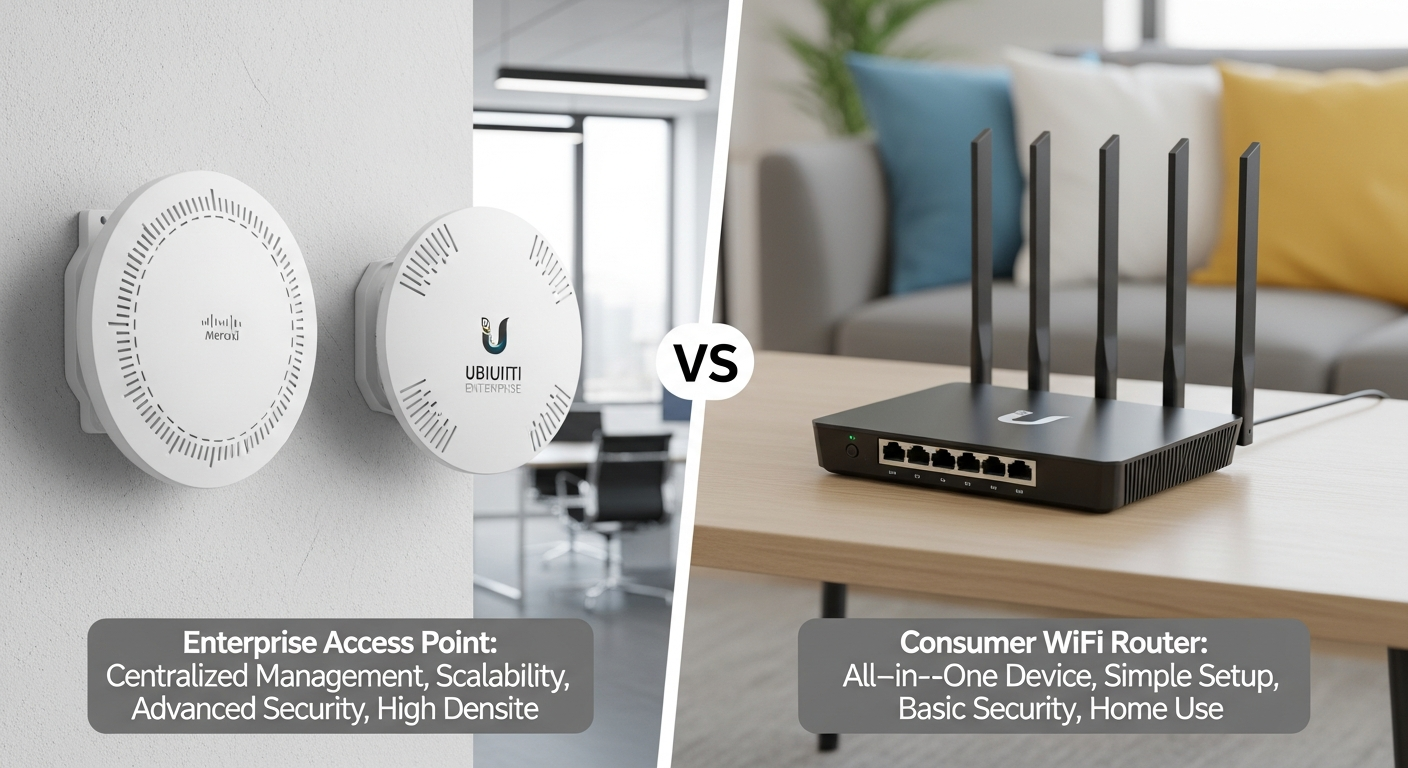
Enterprise WiFi vs Consumer Grade: What Actually Differs
Enterprise access points cost significantly more than consumer routers. Here is what you actually get for that investment.
The Core Difference
Consumer WiFi routers are designed for home use: a small number of devices, low density, non-technical users. Enterprise APs are designed for high-density environments with many concurrent users, centralized management, and predictable performance.
What Enterprise APs Do Better
Centralized management: Enterprise systems (Cisco Meraki, Ubiquiti UniFi, Aruba Instant) provide a single pane of glass for all APs. Push a configuration change and it deploys to every AP in seconds. See per-client statistics, channel utilization, and interference maps from one interface.
Band steering and load balancing: Enterprise APs actively steer clients to the optimal band (5GHz preferred over 2.4GHz) and distribute clients across APs based on signal strength and load.
High-density design: The antenna arrays, radio configurations, and firmware optimizations in enterprise APs are designed for many simultaneous clients. A $200 consumer router starts degrading noticeably at 30+ active clients. A good enterprise AP handles 200+ without issues.
PoE integration: Enterprise APs run on PoE, eliminating the need for power outlets at every mounting location.
Seamless roaming (802.11r/k/v): Clients can move between APs without dropping connections, which matters for voice and video applications.
The UniFi Middle Ground
Ubiquiti UniFi occupies an interesting position: professional hardware and management at prices between consumer and full enterprise. For a homelab or small office, UniFi provides most of the enterprise capabilities without the enterprise price tag.
I run UniFi in my lab. The controller software manages all APs from a single interface, provides detailed statistics, and handles automatic firmware updates.
When Consumer Is Fine
For a home with a handful of devices and no performance-sensitive applications, a good consumer router is perfectly adequate. The investment in enterprise hardware only makes sense when you need the density, management, or reliability features.