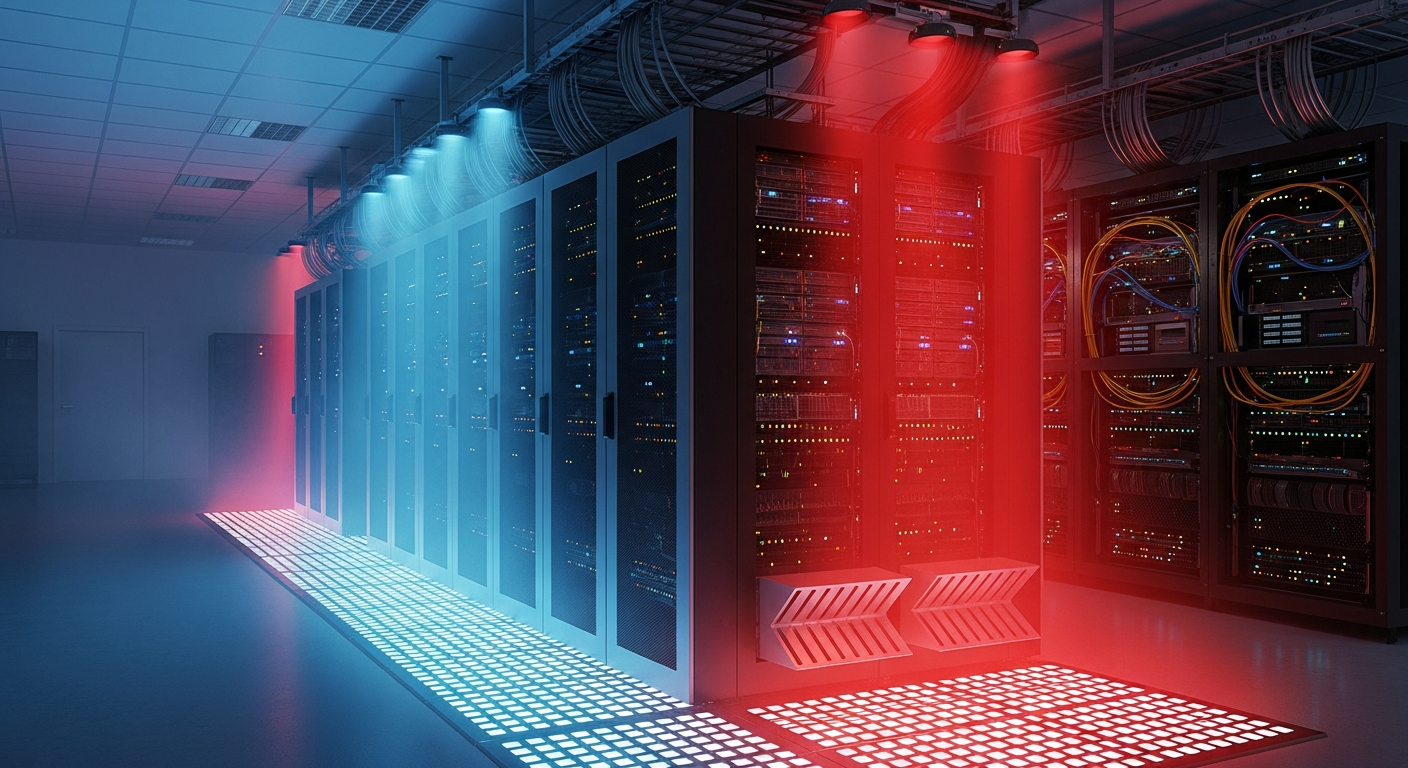
Hot and Cold Aisle Containment: Why Airflow Matters
The principles behind datacenter cooling and how I apply hot/cold aisle concepts even in a homelab environment.
The Problem
Servers generate a lot of heat. A single fully loaded PowerEdge R740 can produce over 1,500 BTU per hour. In a datacenter with thousands of servers, managing that heat is the difference between reliable operation and cascading thermal shutdowns.
The fundamental challenge is that you need to deliver cool air to server intakes and remove hot air from server exhausts without the two mixing. If hot exhaust air recirculates back to the intakes, cooling efficiency drops and servers run hotter than they should.
Hot Aisle / Cold Aisle
The standard approach is to arrange racks in alternating rows so that server intakes face one aisle (cold aisle) and server exhausts face the opposite aisle (hot aisle). Cool air is delivered to the cold aisle through raised floor vents or overhead ducting, and hot air is collected from the hot aisle and returned to the cooling units.
This simple arrangement dramatically improves cooling efficiency because it prevents mixing. Every server gets cool air, and the cooling system only has to deal with concentrated hot air instead of a warm mixture.
Containment
Taking it further, you can physically enclose either the hot aisle or the cold aisle with doors, curtains, or rigid panels. This is called containment. Cold aisle containment seals the cold aisle so cool air can only go into server intakes. Hot aisle containment seals the hot aisle so hot exhaust is captured and returned to the cooling system directly.
In practice, hot aisle containment is more common because it lets the rest of the room stay cool, which is more comfortable for people working in the space.
In a Homelab
I only have one rack, so traditional aisle containment does not apply. But the principle still matters. I make sure all my servers face the same direction, with intakes pulling air from the front of the rack and exhausting out the back. The back of the rack faces a wall with adequate clearance for hot air to dissipate.
I also added a small exhaust fan at the top rear of the rack to pull hot air up and out. Combined with blanking panels to fill empty rack space (preventing hot air from recirculating through gaps), this keeps my equipment running at comfortable temperatures even in a closet.
Key Takeaways
Airflow management is not optional for servers. Hot air recirculation causes thermal throttling, shorter component life, and ultimately failures. Even in a single-rack homelab, filling blank spaces with panels and ensuring consistent airflow direction makes a measurable difference in temperatures.