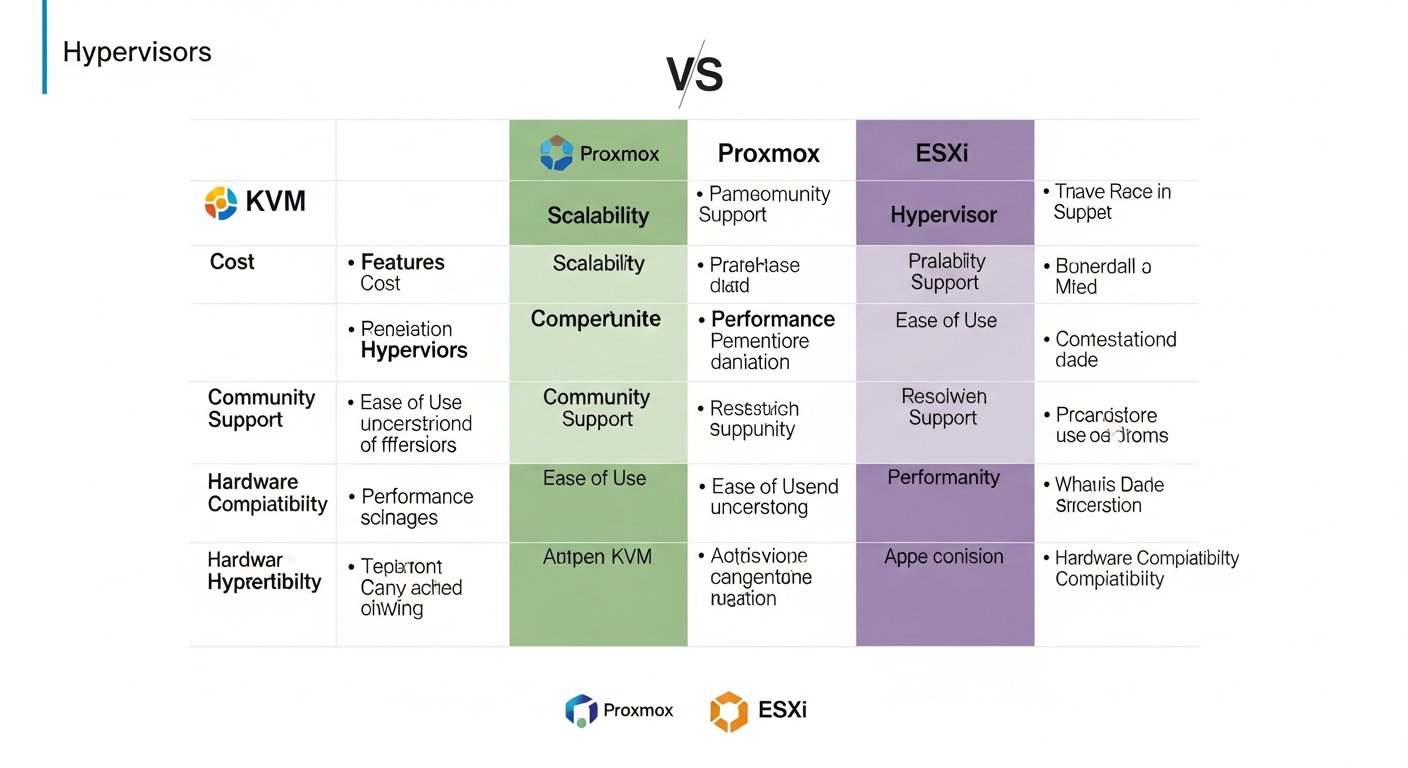
KVM vs Proxmox vs ESXi: Choosing a Hypervisor
Three serious hypervisors, three different trade-offs. Here is how to think about choosing between KVM, Proxmox, and VMware ESXi for your environment.
The Core Question
All three of these platforms run virtual machines. The differences are in management, ecosystem, licensing, and how well they fit specific use cases. Choosing the right one depends on what you are trying to do.
Bare-Metal KVM
KVM (Kernel-based Virtual Machine) is built into the Linux kernel. If you install Ubuntu or RHEL on a server, you already have a hypervisor. Add QEMU for machine emulation and libvirt for management, and you have a complete virtualization stack.
Best for: Developers who want full control, cloud infrastructure builders, or situations where you need to integrate virtualization into a custom system.
Trade-offs: No built-in management UI. You manage everything through the command line or third-party tools like Cockpit or virt-manager. More flexible but more work to set up and operate.
Proxmox VE
Proxmox is built on Debian Linux and KVM, with a polished web UI and built-in features for clustering, high availability, and both VM and container (LXC) management. It is free and open source, with paid support subscriptions available.
Best for: Homelabs, small datacenters, anyone who wants KVM's power with a proper management interface. This is what I run in my homelab.
Trade-offs: The community version works great but shows nag messages about subscriptions. The clustering features require some networking configuration to get right.
VMware ESXi
ESXi is the industry standard in enterprise environments. If you work in a large organization, you almost certainly have ESXi somewhere. It runs as a bare-metal hypervisor with a very thin footprint, and the VMware ecosystem (vCenter, vSAN, NSX) is extremely mature.
Best for: Enterprise environments, organizations that need vendor support, situations where vCenter is already deployed.
Trade-offs: Licensing costs are significant. Since Broadcom's acquisition of VMware, the pricing and licensing model has become much less friendly for small organizations and homelabs. Free ESXi is now unavailable.
My Take
For a homelab or small lab environment, Proxmox is the clear winner. You get all the power of KVM with a proper UI, no licensing costs, and excellent documentation. For enterprise, ESXi remains dominant simply because the tooling and ecosystem are unmatched, even if the cost has increased substantially.