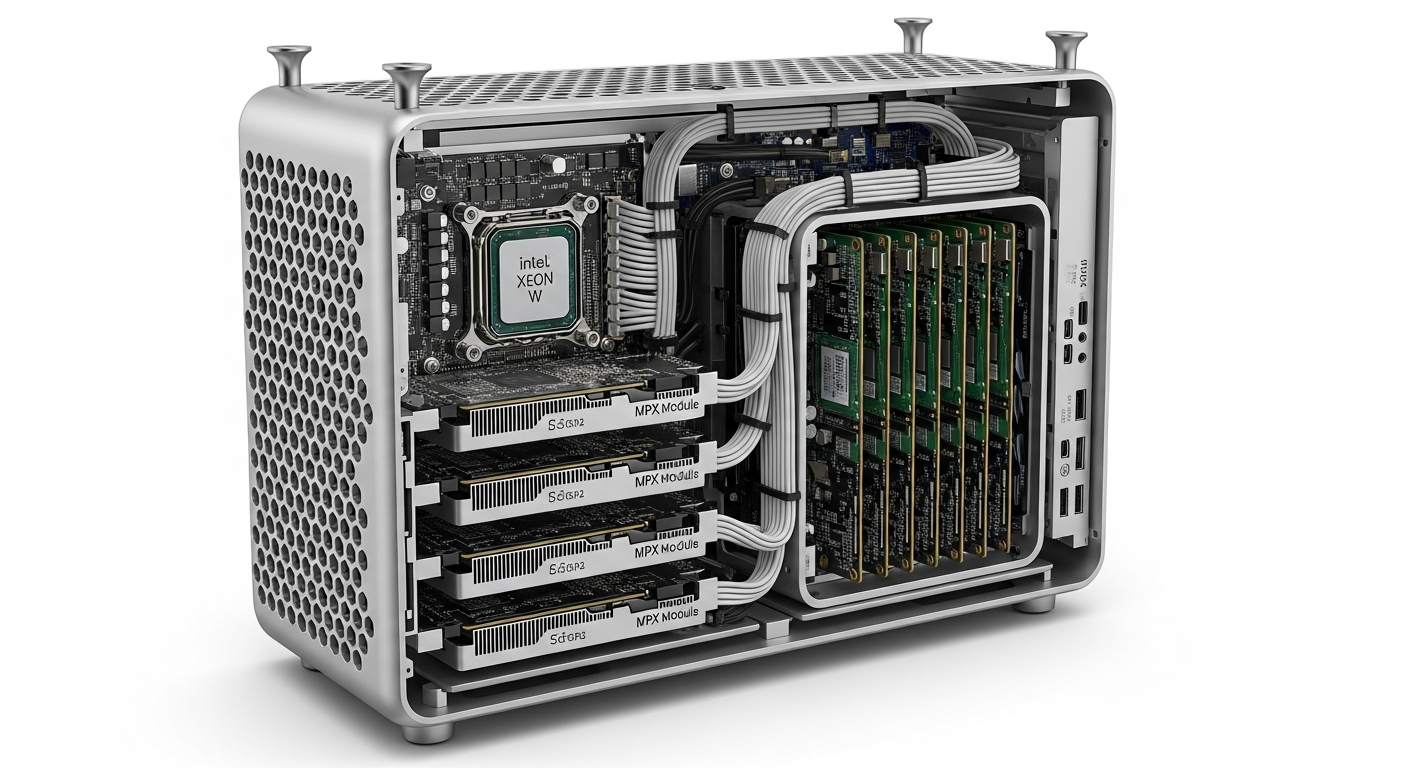
Inside the 2019 Mac Pro: Engineering Analysis
A look at what makes the 2019 Mac Pro's internal design unique compared to traditional server hardware.
The Design Philosophy
The 2019 Mac Pro is the most repairable and upgradeable Mac ever made, which is ironic given Apple's reputation for sealed devices. Every component is user-accessible. RAM, storage, PCIe cards, and even the processor can be replaced or upgraded. The internal layout is clean, logical, and clearly designed by engineers who care about serviceability.
Airflow System
The cooling system uses three large fans at the front of the chassis that pull air across the entire system. Air flows front-to-back, passing over the RAM, CPU, and PCIe cards in sequence. The fan speed is dynamically controlled based on thermal sensors throughout the system.
What makes it interesting is the scale of the fans. Instead of many small fans (like you see in a Dell PowerEdge), Apple uses fewer but larger fans. Larger fans move more air at lower RPMs, which means the Mac Pro is remarkably quiet for a system of its power class.
The MPX Module System
Apple's MPX (Mac Pro Expansion) module system provides both PCIe and auxiliary power through a single connector. Standard PCIe cards work in the Mac Pro, but Apple's MPX modules (like the Radeon Pro Vega II) get additional power and Thunderbolt connectivity through the custom connector.
This is clever engineering. It means GPU cards can draw much more power than the standard PCIe specification allows, which enables Apple to use high-power professional GPUs without external power cables.
Memory Architecture
The Mac Pro supports up to 1.5 TB of DDR4 ECC memory across 12 DIMM slots. The memory is arranged in a six-channel configuration, which provides massive bandwidth. Apple uses industry-standard R-DIMMs, so you can buy memory from any server memory supplier.
Compared to Traditional Servers
The biggest difference is density. A PowerEdge R740 packs dual processors, 24 DIMM slots, and 16 drive bays into a 2U chassis. The Mac Pro is a full tower (or 5U in rack-mount form) with a single processor and fewer DIMM slots. You give up density for noise, thermal management, and build quality.
For datacenter use where density matters, the Mac Pro loses. For a lab or studio environment where noise and quality of life matter, the Mac Pro is in a league of its own.