The Apple Afterburner Card: Hardware Video Acceleration
What Apple's Afterburner accelerator card does, how it works, and why hardware-accelerated ProRes decoding matters.
What Afterburner Does
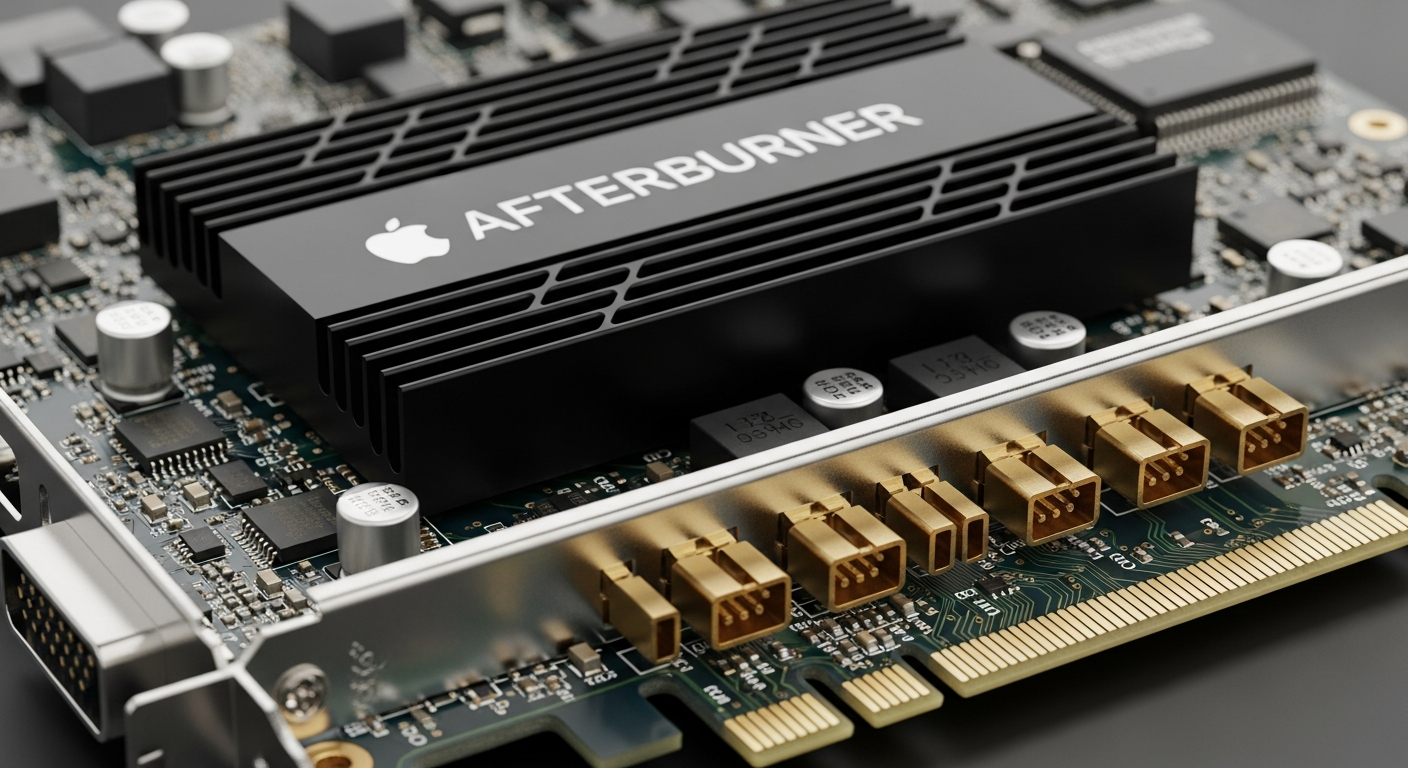
The Apple Afterburner card is a PCIe accelerator designed to decode ProRes and ProRes RAW video in hardware. It handles up to 6.3 billion pixels per second, which translates to 3 streams of 8K ProRes RAW or 12 streams of 4K ProRes RAW simultaneously. Without Afterburner, these decode operations happen on the CPU, which limits how many streams you can play back in real time.
Why It Matters
In video post-production, editors need to scrub through high-resolution footage in real time. ProRes is Apple's professional codec, used widely in film and broadcast. Raw footage from professional cameras is enormous. A single stream of 8K ProRes RAW produces about 4 GB per minute.
Without hardware acceleration, playing back multiple 4K or 8K streams simultaneously would require an extremely powerful CPU. Afterburner offloads this work to a dedicated FPGA (field-programmable gate array), freeing the CPU for other tasks like effects rendering and compositing.
The Hardware
Afterburner is built on a Xilinx FPGA. Apple programmed the FPGA with their ProRes decode logic, creating a purpose-built accelerator that is more power-efficient than doing the same work on a general-purpose CPU or GPU. The card draws about 25 watts and occupies a half-length PCIe slot.
This approach is interesting from an engineering perspective. FPGAs can be reprogrammed, which means Apple could theoretically update the card to support new codecs or improved decode algorithms through a firmware update. Whether they actually will is another question.
In Practice
In my setup, Afterburner makes a noticeable difference when working with ProRes footage in Final Cut Pro. Timeline scrubbing is instant, even with multiple 4K streams and effects applied. Without Afterburner, the same timeline would stutter and drop frames.
For anyone doing serious video work on a Mac Pro, the Afterburner card is one of the most cost-effective upgrades available. It turns the Mac Pro from a powerful workstation into a dedicated video processing machine.
The Bigger Picture
Afterburner is a good example of how hardware acceleration can transform specific workloads. The same principle applies to GPU-accelerated machine learning, FPGA-based network packet processing, and ASICs designed for cryptocurrency mining. When you can move a compute-intensive task from general-purpose hardware to dedicated hardware, the performance and efficiency gains are dramatic.