Power over Ethernet: How PoE Works in Enterprise Networks
PoE eliminates the need for separate power supplies for IP phones, cameras, and wireless APs. Here is how the standard works and how to plan for it.
What PoE Does
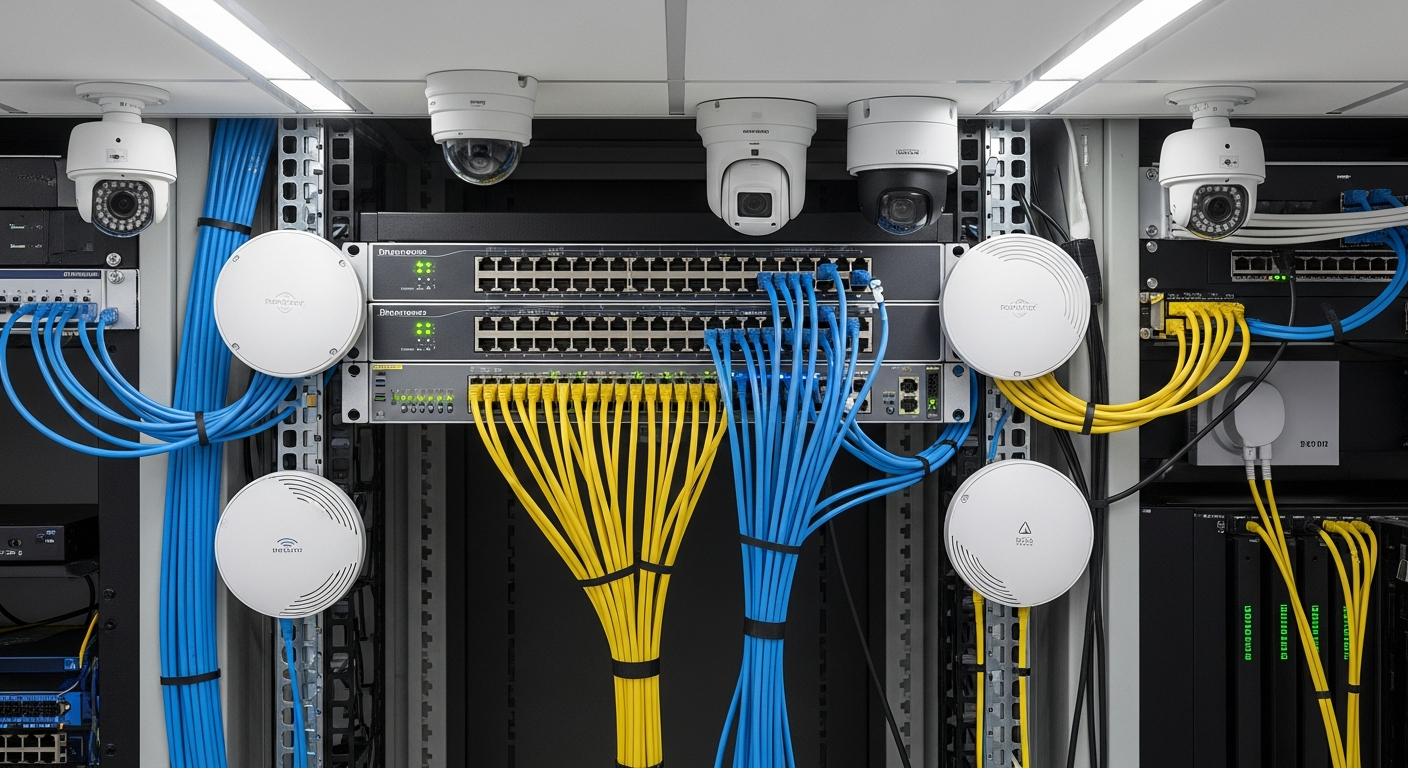
Power over Ethernet delivers electrical power over standard Ethernet cabling, allowing devices like IP phones, wireless access points, and security cameras to operate without a separate power supply. A PoE switch powers the device through the same cable that carries data.
The Standards
PoE (IEEE 802.3af): Original standard, up to 15.4W per port. Sufficient for basic IP phones and low-power APs.
PoE+ (IEEE 802.3at): Up to 30W per port. Handles most access points and PTZ cameras.
PoE++ (IEEE 802.3bt): Up to 60W (Type 3) or 100W (Type 4) per port. Powers high-performance APs, thin clients, and even small displays.
Planning PoE Budgets
Every PoE switch has a total power budget shared across all ports. A 24-port switch might have a 370W budget. If you connect 24 PoE+ devices drawing 25W each, that is 600W, which exceeds the budget. Some ports will not receive full power.
Calculate your power requirements before deploying. Group high-power devices carefully and check the switch's documentation for per-port power limits and total budget.
How It Works
The switch (PSE - Power Sourcing Equipment) applies a small voltage to the cable and checks for a signature resistor in the connected device (PD - Powered Device). If the signature matches an IEEE 802.3 profile, power is enabled. This prevents accidents with non-PoE equipment.
Practical Considerations
- Check that the cable quality supports PoE, particularly for longer runs
- Use cable testers that can verify PoE voltage and current
- Consider inline PoE injectors for individual devices in environments without PoE switches
- Monitor per-port power consumption in the switch management interface for troubleshooting
PoE simplifies physical deployments significantly. The ability to mount an AP or camera anywhere you can run a cable, without running power separately, is a real advantage.