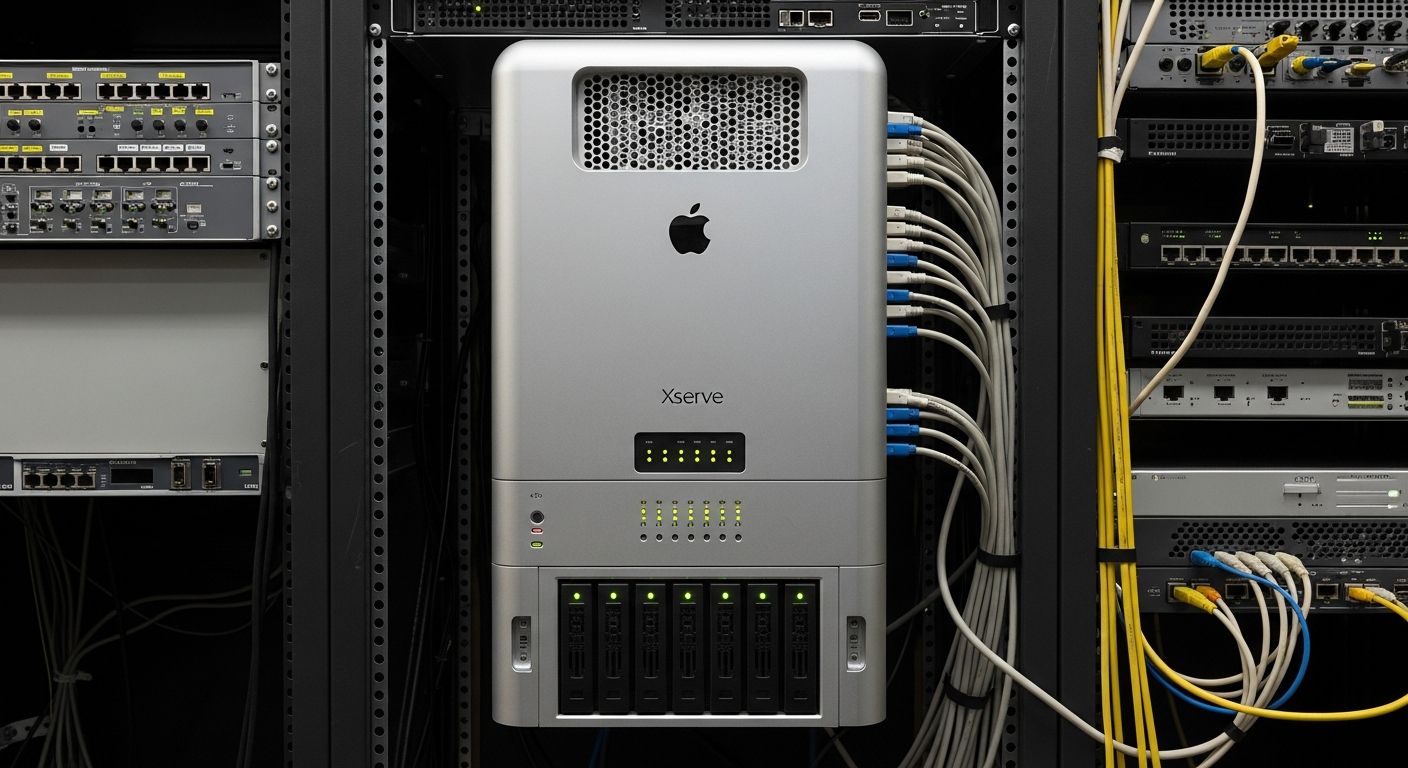
The Apple Xserve: A Look at Apple's Server Legacy
Apple used to make rack-mount servers. Here is why the Xserve mattered, why Apple killed it, and what it means for the Mac Pro.
What Was the Xserve
The Apple Xserve was a 1U rack-mount server that Apple sold from 2002 to 2011. It was a real server: rack-mountable, hot-swappable drives, dual processors, ECC memory, and server-grade management tools. Apple paired it with macOS Server and Xsan (a clustered filesystem) to provide a complete Apple-native server stack.
Why It Mattered
The Xserve was the only Apple product designed specifically for the datacenter. It ran macOS Server, which provided file sharing, directory services (Open Directory), email, web hosting, and other server functions natively on Apple hardware. For organizations running all-Apple environments, the Xserve was the obvious server choice.
Creative studios, universities, and media companies adopted Xserve for render farms, file servers, and collaboration infrastructure. It integrated seamlessly with Mac workstations in ways that Windows or Linux servers could not.
Why Apple Killed It
Apple discontinued the Xserve in 2011 because the server market is fundamentally different from the consumer market that Apple dominates. Server customers want long product lifecycles, extensive support contracts, standardized management tools, and competitive pricing. Apple wanted to sell premium consumer devices.
The Xserve never achieved the volume needed to justify Apple's investment in server-specific engineering. Dell, HP, and IBM were selling millions of servers. Apple was selling thousands.
The Mac Pro as Spiritual Successor
The 2019 Mac Pro in rack-mount configuration is the closest thing to a modern Xserve. It fits in a standard rack, supports ECC memory, and can run macOS server workloads. But it is designed as a workstation, not a server. It lacks the server-specific features (hot-swap drives, redundant power supplies, IPMI) that made the Xserve a real server.
What This Means
Apple has effectively exited the server market. If you need macOS in a rack, the Mac Pro is your only option, and it is an expensive, imperfect one. For everything else, Dell, HP, and Supermicro offer better value, better management, and better support.
The Xserve was ahead of its time in build quality and design. But it was in a market that Apple was never willing to commit to fully. That tension is the story of Apple in the enterprise.